If you’re not scared or angry at the thought of a human brain being controlled remotely, then it could be this prototype of mine is finally starting to work. —John Alejandro King
Heidi is scaring me
Really scaring me…:

Could be worse. Could be Klingon furries. All dressed up like targs.
Close the windows, fall’s coming
ABC News: Could Docs Save Man with Bomb in Body?:
Making Light: “I don’t need to know the details.”:
I think there’s an idea here without a clear term to point to it: ideologies that require or encourage a kind of willful ignorance. Those can be cured, but only by breaking with the ideology.
Frex, a lot of economic determinists (Marxists and neoclassical economists) seem to have the idea that they don’t need to know much about the world to understand it, because their economic models give them the fundamental insights. I think the screwups in Iraq have largely been caused by very smart people whose ideology led them to think that they had grasped the essentials of the situation there, despite scary stuff like not knowing the difference between Shia and Sunni. I think there’s also a widespread idea in management that you should be able to manage things whose details you don’t understand all that well. (But that’s way outside my field or interests, so I may just be misunderstanding.)
The hard thing is, you *have* to have simplifying models — they’re what make a fiercely complex world usable. But your model can really screw you, by convincing you that you know the important stuff, even when you’re frightfully ignorant of the details. And people with very powerful or convincing models often get screwed in just this way, as they try to apply their powerful model from one situation into a different one. Even worse, some models’ strength is that they make for good rhetoric, and when tested against the real world, they fail horribly. But group decisionmaking is largely done through rhetoric — both national politics and internal politics of most groups. You can have disastrous ideas that win all the arguments, sound great, and reliably gain power — I’d say that the rhetoric about the Middle East being ripe for democracy, democracy leading to peace, etc., is a good example of that.
Science Fiction Writer Admits Unstoppable Killing Machine Based On Mother: Sure, you only think the Onion made it up.
Second Hand Songs: a cover songs database.
Why should God bless America? Because if we have people like this in the country, we need all the blessings we can get.
Related: Windows users 20% more interested in God than Mac users – Boing Boing:
Thoof has done some analysis of the data collected by their recommendation algorithm, and discovered some interesting differences between Mac users and Windows users. For example, it seems Windows users are 20% more interested in religion, but 6% less interested in intellectual property law.
Getting Things Done: David Allen on Managing Your Stuff with GTD – video – Lifehacker
I’m sorry, but I have to ask…
Famed French mime Marcel Marceau dies – Yahoo! News:
Marcel Marceau, whose lithe gestures and pliant facial expressions revived the art of mime and brought poetry to silence, died Saturday. He was 84.
…what were his last words?
It wasn’t me…
…and too many people would break my ribs if I did.
Clooney breaks rib in motorcycle crash – Yahoo! News:
WEEHAWKEN, N.J. – George Clooney suffered a broken rib and some scrapes on Friday when the motorcycle he and a friend were riding collided with a car as the actor tried to pass the other vehicle, authorities said.
Weehawken Police Sgt. Sean Kelly said the collision occurred at 3:30 p.m. as Clooney and friend Sarah Larson were traveling north on Boulevard East and sped up to pass on the right a 1999 Mazda Millenia that was preparing to make a right turn.
Kelly said it is not known if the driver of the other vehicle, who has not been identified, had used his turn signal. Boulevard East is a narrow road with sweeping views of the Manhattan skyline.
“It’s a he-said, she-said right now, but you can’t pass on the right in Weehawken or anywhere in Jersey,” Kelly said.
Kelly said the accident remains under investigation and no summonses have been issued.
The 46-year-old actor was treated at Palisades Medical Center in North Bergen and released, spokesman Stan Rosenfield said in a statement.
“He’s doing fine,” Rosenfield said. “He has a broken rib, it’s very painful and it’ll take a long time to heal.”
Larson suffered a broken foot. Both she and Clooney were wearing helmets, Kelly said.
As always…
…we still remember. Or, depending on your point of view, we can’t forget.
And sadly, this year, we also have to remember the author, John M. Ford. If you don’t know Mike Ford’s other work, start here and here.
500 days and counting…
Bush has bad day at Sydney Opera House – Yahoo! News:
SYDNEY, Australia – President Bush had a terrible, horrible, no good, very bad day at the Sydney Opera House.
He’d only reached the third sentence of Friday’s speech to business leaders, on the sidelines of the Asia-Pacific Economic Cooperation forum, when he committed his first gaffe.
“Thank you for being such a fine host for the OPEC summit,” Bush said to Australian Prime Minister John Howard.
Oops. That would be APEC, the annual meeting of leaders from 21 Pacific Rim nations, not OPEC, the cartel of 12 major oil producers.
Bush quickly corrected himself. “APEC summit,” he said forcefully, joking that Howard had invited him to the OPEC summit next year (for the record, an impossibility, since neither Australia nor the U.S. are OPEC members).
The president’s next goof went uncorrected — by him anyway. Talking about Howard’s visit to Iraq last year to thank his country’s soldiers serving there, Bush called them “Austrian troops.”
That one was fixed for him. Though tapes of the speech clearly show Bush saying “Austrian,” the official text released by the White House switched it to “Australian.”
Then, speech done, Bush confidently headed out — the wrong way.
He strode away from the lectern on a path that would have sent him over a steep drop. Howard and others redirected the president to center stage, where there were steps leading down to the floor of the theater.
The event had inauspicious beginnings. Bush started 10 minutes late, so that APEC workers could hustle people out of the theater’s balcony seating to fill the many empty portions of the main orchestra section below %u2014 which is most visible on camera.
Even resettled, the audience remained quiet throughout the president’s remarks, applauding only when he was finished.
A logistical glitch added to the woes.
APEC security workers would not allow the members of the media who travel in Bush’s motorcade to enter the Opera House along with him. This even though the journalists allowed into the president’s entourage are extensively screened and guarded by the Secret Service, which has more stringent security standards than about any operation in the world. And even though they always accompany him into public events.
As a result, while Bush spoke, the traveling media cooled its heels outside the landmark Opera House, shooting pictures and watching boats in the harbor.
(Via Eric Avedissian.)
Getting back into the swing of things
There are a few people who have complained about my paucity of posting over the summer– even though I’ve been blogging at ComicMix semi-regularly, they want to see stuff that doesn’t have to deal with funnybooks.
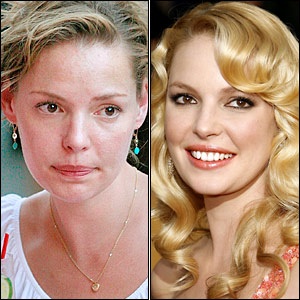 You have but to ask. Back to an occasional theme here: Celebrities without makeup, stars without makeup, dress up and make up gallery.
I mention this one in particular because of this picture of Katherine Heigl, most recently seen in the movie Knocked Up. A number of folks complained how unrealistic it was for a hottie like Ms. Heigl to hook up with a shlub like Seth Rogen. I’d like to point out that Ms. Heigl doesn’t always look like a million bucks either. If she can clean up to the levels we see in film and TV, so can Mr. Rogen. And so can 90% of the people in the world, if not 95%.
John Cleese’s eulogy
Apparently, not content with delivering Graham Chapman’s eulogy, he’s decided to deliver his own.
Closing even more windows…
If this keeps up, I’m going to turn into Avedon.
A panel of judges at the American Bar Association%u2019s meeting in San Francisco last week reported on threats to judges for crossing the religious right:
More than two years after enraging right-wing groups by ordering Terry Schiavo%u2019s feeding tube removed, George Greer still peers over his shoulder nervously at times%u2026
Two years ago, he said, someone in the Bay Area threatened to kill him over his decision to end life support for the brain-damaged Schiavo. And even though that person was prosecuted and jailed, Greer said, he%u2019s taking no chances.
%u201CIt is a little unnerving,%u201D he said. %u201CI still can%u2019t see a strange car come down my street without wondering [who%u2019s behind the steering wheel].%u201D
Greer was one of four current or former judges who appeared in a 90-minute seminar in Moscone Center West to describe how their lives were affected by their rulings in high-profile cases involving hot-button issues.
Besides Greer, there was New Jersey Supreme Court Justice Roberto Rivera-Soto, who 10 months ago participated in a ruling saying gay and lesbian couples deserve the same rights as married couples, but stopped short of approving same-sex marriage.
Eileen O%u2019Neill, a former Texas judge who in 1993 held Operation Rescue founder Randall Terry and other anti-abortion activists in contempt for violating an order directing them to quit harassing several Houston-area doctors, was on the panel. And so was former California Supreme Court Justice Cruz Reynoso, kicked off the bench by voters in 1986 along with two other justices for reversing death sentences.
All four spoke about the consequences of their actions, but stood firmly behind them, while fretting somewhat about the political and social pressures facing judges these days. Unstated, but hovering in the ether, was the fact that many judges believe the current presidential administration has exacerbated the problem by blaming unpopular rulings on %u201Cactivist judges.%u201D
The Infamous Brad – Another Interruption. Ah, Fame. *eyeroll*:
In his excellent (if a trifle dry) A History of News, one of Mitchell Stephens’ insights to offer is that normal professional journalists (as opposed to that much rarer breed, investigative journalists) always “know” what the story they’re going to write is going to be before they even talk to a single source. How do they do this? Stephens says that there are probably fewer than 200 stories that can be written, period, that anybody who reads or watches the news ever wants to hear. He calls these recurring news story outlines the ur-stories, meaning the primal or elemental news stories from which all later news stories are descended. So the reporter shows up at the scene of a news story with an outline of a story in their head, learned in journalism school, and all they need is three one-sentence quotes for color, and the correct spelling of each person’s name. If it’s an in-depth report, they go to their editor or publisher’s rolodex and pull out the names of two “experts” who can be counted on to have opposing views on the subject and call each expert for another single-sentence quote. This is journalism as it is genuinely practiced. (Which, come to think of it, is relevant to what I was going to write tonight, more about that tomorrow.)
And it is my observation that there are only three ur-news stories that can possibly be written about a weird subculture or one of its members. I call them “Funny Zoo Animals,” “Threat or Menace,” and “Surprisingly Nice.” And I’ll tell you right now that the odds of you getting that last story are hundreds to one against. “Funny Zoo Animals” is the freak-show piece: look at the harmless, funny, crazy people. Aren’t they so cute? And oh, look, there are even some in this town! Isn’t that funny? It’s always vaguely condescending in tone; that’s what that story is about. People read it to reassure themselves that they’re better off normal. “Threat or Menace” takes its name from an old Reader’s Digest article about the Communist Party USA entitled: “Communism: Threat? or Menace?” Because in that story, that’s the whole range of possible opinion given: either the weird subculture in question is an impending threat or an already-serious menace. The weirdos in question are portrayed as dangerously crazy, likely to do anything, and very interested in recruiting your spouse and your children. “Are your children safe?” Experts will be quoted who say no. Any quotes you give will be selected for how crazy and stupid they can make you sound, any expert quoted as being on your side will be hand-selected for how easily they can be dismissed by other experts.
No, the best you can ever hope against hope for is, “Surprisingly Nice,” where the story starts off being how weird and silly (or weird and menacing) you and your subculture seem to be, still reinforcing one of those two stereotypes, “but (person’s name) turned out to be surprisingly nice.” This is the story that people try to get reporters to write when they talk to a reporter about some charity work that they’ve done, from Pagans or the KKK doing Adopt-a-Highway litter cleanup to biker gangs raising money for children’s hospitals or veterans’ hospitals. But reporters hate the “Surprisingly Nice” story because they take it for granted that they’re being manipulated. They know that you’re distorting how you really are in hopes of getting some favorable publicity, in hopes of getting somebody in particular or the public in general off of your back. So it takes a lot of years of very successful charity work to get a “Surprisingly Nice” story, and if you don’t believe me, look at how many literal millions of dollars worth of charity Penny Arcade has done for impoverished children on behalf of computer- and console gamers and how little favorable publicity they’ve gotten for it. No, the only time you really have anything better than a very long shot chance at getting “Surprisingly Nice” is when some inexplicable tragedy hits. Cancer is OK, but having your child murdered is better. The best way to get a “Surprisingly Nice” story is to come down with some fatal, wasting disease that strikes truly at random but leaves you looking photogenic; that’s always good for media sympathy. (Call it, if you will, the La Boheme variation on “Surprisingly Nice,” as in yeah this person is very weird, but even journalists admit that nobody photogenic deserves an awful fate.) Otherwise, forget it; what you’re going to end up in is “Funny Zoo Animals” or “Threat or Menace.”
The Wackiest Cover Songs on the Web Article from Blender and the 100 worst cover songs from retroCRUSH.